About This Book
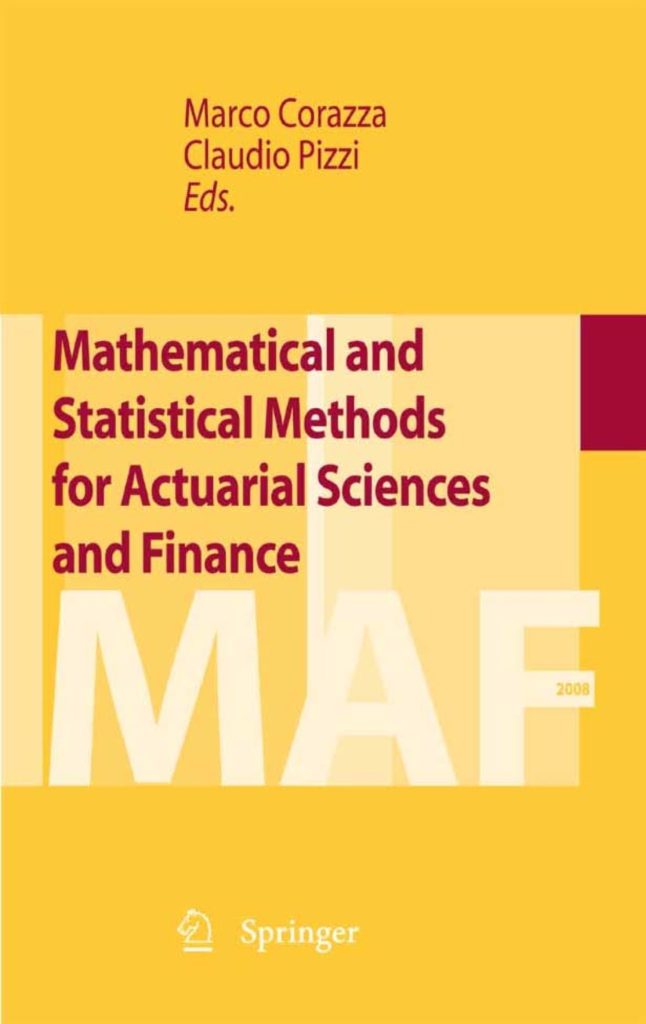
Mathematical and Statistical Methods for Actuarial Sciences and Finance is a methods text whose title is its syllabus: the mathematical and statistical machinery built for the actuarial sciences and for finance. The destination heading gives the exact title; the file served there, ‘Mathematical and Statistical Methods for Actuarial Sciences and Finance.pdf’, carries the exact title itself — the same volume under the filename the site serves it by. The book’s work is foundational: assembling the probability, statistical inference, and financial mathematics on which actuarial practice and quantitative finance both stand.
Actuarial science begins from a paradox: individual lives are unpredictable and populations are not. No method can say when one policyholder will die; the law of large numbers says, with remarkable precision, how many of a hundred thousand will — and an entire industry prices promises on that gap between personal uncertainty and aggregate regularity. The mathematical methods gathered for such a science therefore run in a characteristic direction: from distributions describing mortality, claim sizes, and lifetimes, through statistical techniques for fitting those distributions to real experience data honestly, to the financial mathematics that moves money through time — interest, discounting, annuities, and the valuation of cashflows that arrive, if they arrive, decades late. Finance shares the engine room from the other door: asset prices are modelled as random processes, risk is measured as dispersion and tail behaviour, and the same inference machinery tests whether the models deserve their confidence. A methods book standing across both fields is making an accurate claim about the world — beneath the actuary’s premium table and the analyst’s portfolio model sits one toolkit, and mastery of it is what separates the professional who uses formulas from the one who knows when they lie. For students, such a volume is also a rite of passage: the point where mathematics stops being examination gymnastics and becomes the load-bearing structure of a career spent pricing the future.
What Learners Will Practise
Modelling Uncertainty with Distributions
Readers practise the field’s founding move: describing mortality, lifetimes, and losses as probability distributions, then letting aggregation turn individual unpredictability into workable regularity. The distribution is the actuary’s unit of thought.
Moving Money Through Time
The book practises the financial mathematics of interest and discounting — valuing promises payable in decades as present sums — the arithmetic on which premiums, reserves, and annuities all depend. Time is treated as a dimension with a price.
Fitting Models to Experience
Students practise statistical inference against real data: estimating parameters, testing fit, and doubting a model in an organised way. Honest fitting is what keeps aggregate regularity from becoming aggregate self-deception.
Key Features
The double allegiance is the feature: one mathematical toolkit presented where it belongs, underneath both actuarial science and finance at once. The foundational stance is the second — methods derived and understood, not formulas merely applied — and the shelf fit the third, the engine room beside this list’s cheerful learning method and its public finance criteria. On this shelf it prices the future here.
Who This Book Is For
Actuarial students are its first audience, building the mathematical core their examinations and careers both assume. Finance analysts and quantitative specialists form its second readership, auditing the assumptions under their models. Mathematicians and statisticians crossing into either field make its third, learning where their theorems are load-bearing.
How to Use This Book
Work it with pencil and data, not as reading alone: derive each method once by hand before trusting it to software. Keep the applications in view — price a small promise, fit a small dataset — so the abstractions stay moored to the profession’s questions. Return to it when a model misbehaves; methods texts are consulted most profitably at the moment of failure.
Related Books
The shelf’s cheerful method stands at Laugh and Learn, and its public finance criteria at Public Finance Criteria.